
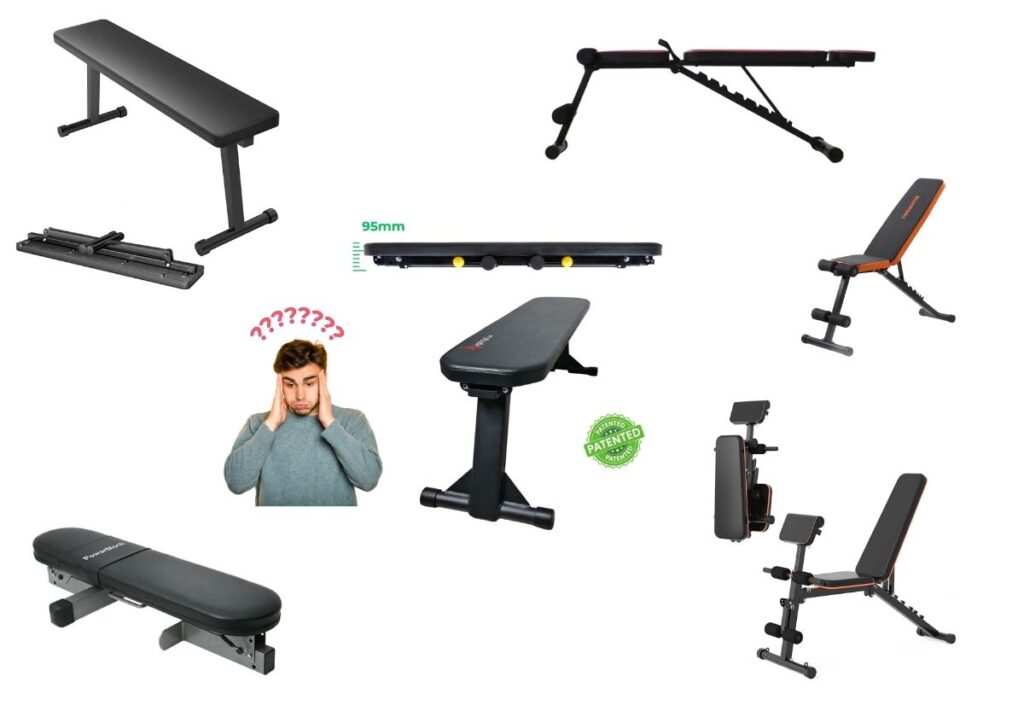
Foldable weight benches have become an essential piece of equipment in any weight bench home gym setup, right alongside dumbbells, barbells, and squat racks. Their compact, space-saving design makes them ideal for modern living spaces—especially small apartments or multipurpose rooms. More than just a platform for the classic bench press, a foldable weight bench supports a full-body workout: from one-arm dumbbell rows to Bulgarian split squats, tricep dips, and beyond.
Choosing the right foldable weight bench for home workouts can be challenging, especially when space, stability, and long-term durability all matter. With a growing variety of foldable benches for home gyms available online, picking the right one can feel overwhelming. Pictures and product specs only tell part of the story. That’s why, in this expert guide based on 20 years of hands-on experience designing and outfitting home gyms, I’ll walk you through the most important factors: the types of foldable weight benches, what features to look for, and how to choose the best model for your training needs and space.
The short answer
A good foldable weight bench for home training should:
- feel as solid as a fixed bench: wide, four-point base, legs wider than the pad, no play in the locked position;
- carry far more than you lift: a load rating of at least 300 kg (user + weights), ideally confirmed by an independent test;
- be built from thick steel: 2–3 mm tubing for the frame, thicker plate for the legs;
- fit your body: pad about 1070–1200 mm long and 290–320 mm wide, 420–450 mm high;
- fold flat, not just small: under 10–12 cm folded so it slides under a sofa or hangs on the wall;
- lock positively: a safety pin or lock you can check at a glance, set up in seconds.
Why Most Foldable Weight Benches Feel Unstable at Home
Many people hesitate to buy a foldable weight bench because they assume it will wobble, flex, or feel unsafe. In reality, instability usually doesn’t come from the folding concept itself — it comes from poor design.
The most common causes of instability include thin steel profiles, weak connection points, and overly complex folding mechanisms. When a bench relies on too many moving parts, even small tolerances can create movement under load.
Another frequent issue is narrow base support. Benches with legs that are not wider than the padding tend to feel unstable, especially during unilateral exercises such as Bulgarian split squats or one-arm dumbbell rows.
A well-engineered foldable weight bench should feel solid during use and only “fold” when you intentionally want it to — not while you’re training.
What Is a Weight Bench and What Is It Used For?
The term “weight bench” generally refers to a bench used primarily for bench pressing, but in reality, it’s a highly versatile workout platform. With a bench, you can perform a wide variety of exercises at home, such as:
Bench press
One-arm dumbbell rows
Skull crushers (triceps)
Bulgarian split squats
Tricep dips
Step-ups
Bench jumps
Glute bridges
Dumbbell pullovers
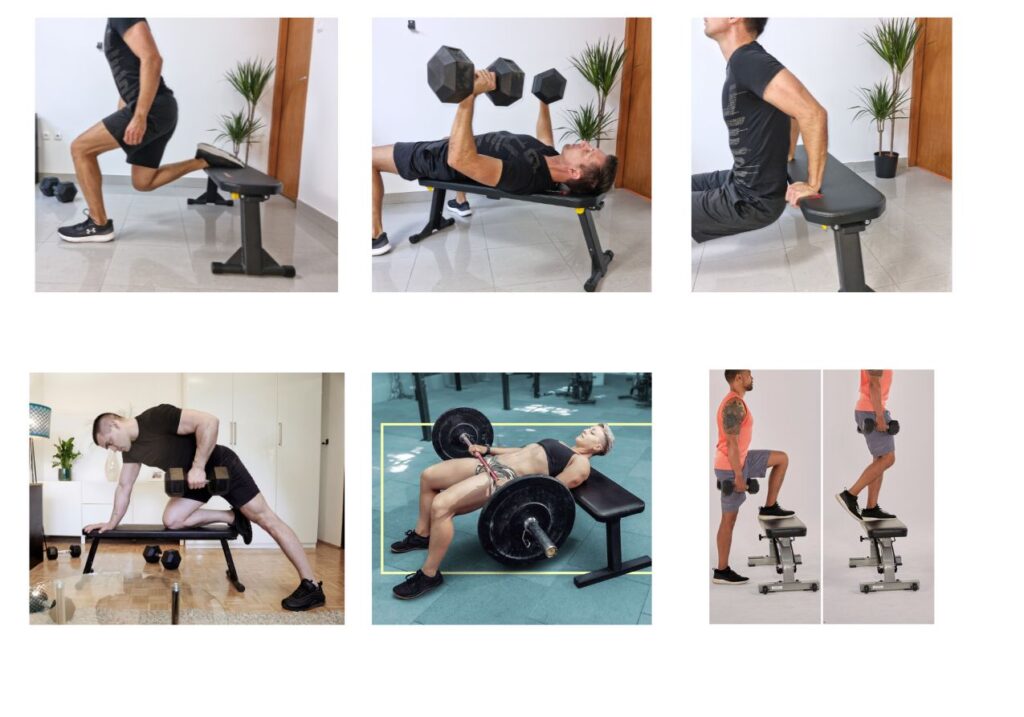
This variety allows users to train multiple muscle groups effectively without needing a lot of different machines. Especially for home gyms, where space and budget might be limited, a weight bench becomes an essential multi-functional tool.
A bench typically consists of a metal frame and a padded top. Foldable benches also include a mechanism that allows them to collapse into a more compact shape, which is ideal for storage in tight living spaces.
Weight Bench Types Compared
Given the vast market and varied preferences of users, here are the key types of weight benches:
Fixed weight bench:
Flat bench
Incline (adjustable) bench
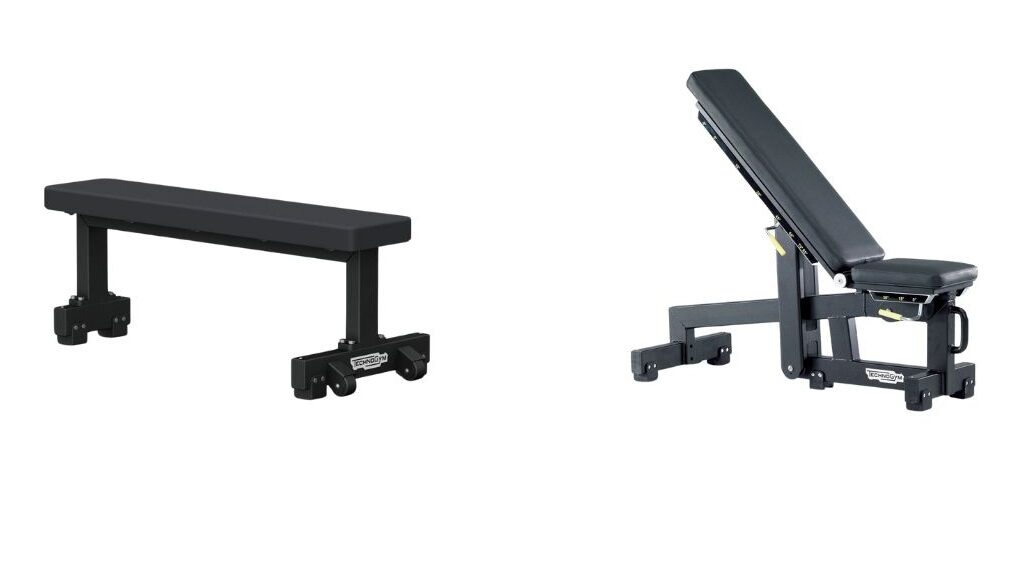
Foldable weight bench:
Flat foldable weight bench
Incline foldable weight bench
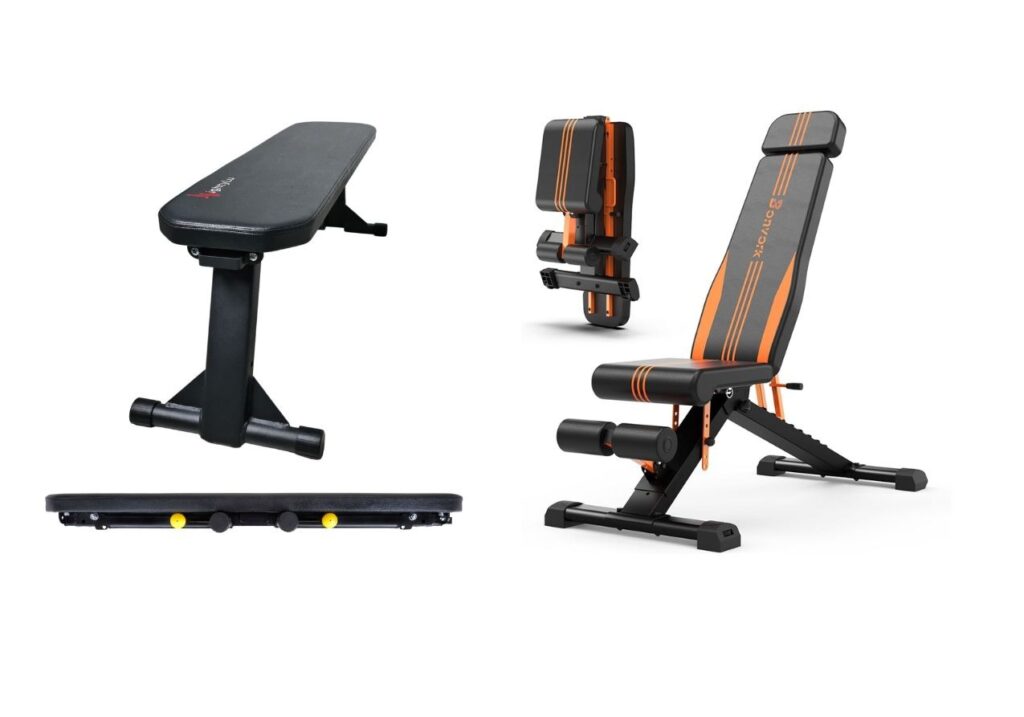
Each type comes with its own set of advantages. Fixed benches often offer more stability due to fewer moving parts, while foldable ones are preferred for compact spaces. The table below sums up the trade-offs:
| Bench type | Stability | Exercise range | Storage | Best for |
|---|---|---|---|---|
| Fixed flat bench | Very high | Flat pressing, rows, step-ups, split squats | Takes permanent floor space | Dedicated gym rooms and garages |
| Fixed adjustable (incline) bench | High, depends on the adjustment mechanism | Flat, incline and shoulder pressing | Bulky, heavy to move | Chest-focused training with a permanent setup |
| Foldable flat bench | High, if the frame and legs are well engineered | Flat pressing, rows, step-ups, split squats, dips | Folds flat; can go under furniture or on a wall | Apartments and multi-purpose rooms |
| Foldable incline bench | Medium; more joints mean more potential play | Flat and incline pressing | Folds, but usually into a thicker, boxy shape | Incline work when you can store a bulkier package |
If you’re unsure whether you need a standalone bench or a bench press bench with uprights, this detailed comparison explains the key differences.
Flat or Incline Foldable Weight Bench: Which Is Right for You?
Let’s clarify one of the most common dilemmas when choosing a foldable weight bench for a home gym: flat or incline?
If your main focus is pressing movements like bench press or shoulder press, go for an incline bench that allows angle adjustments. On the other hand, if you plan on doing various exercises like dumbbell rows, bench jumps, Bulgarian squats, and conditioning workouts, a flat bench may be a better choice.
There are two major differences in the build between flat and incline foldable benches:
Flat benches typically have one continuous pad, while incline benches have two sections, often leaving a noticeable gap that can get in the way during some exercises.
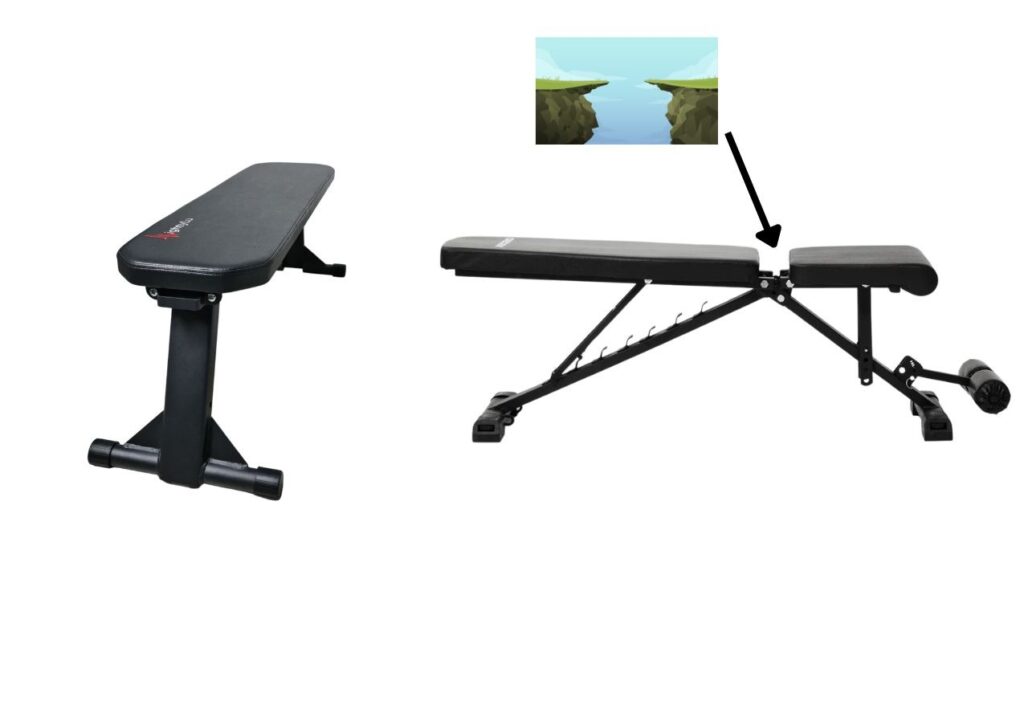
Flat benches, lacking an incline mechanism, are generally more stable and rigid. Incline benches include folding and adjustment mechanisms, which inevitably create some slack, possibly causing wobbling. While some brands minimize this issue, they usually come with a much higher price tag.
In summary: If you want maximum versatility, go with a flat bench. If your primary goal is chest development, an incline bench is the way to go.
Pro Tip: Turn a Flat Bench into an Incline Bench
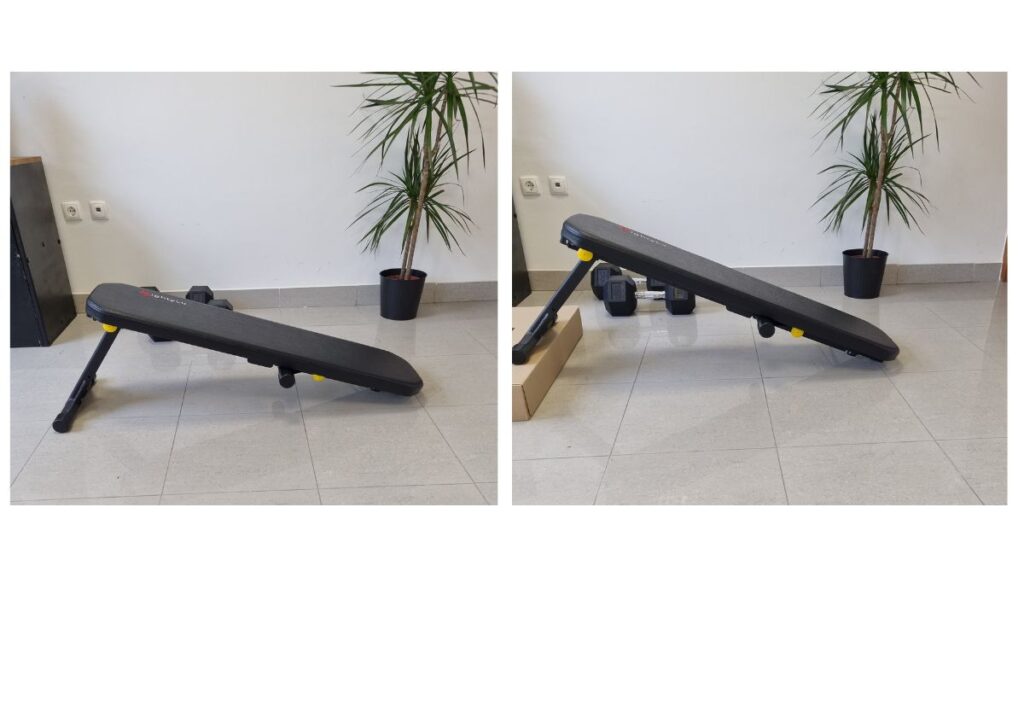
Most foldable flat benches have legs that fold in for storage. If you fold just one leg and prop it up, you can create an incline angle. Adjust the incline by adding different supports under the folded leg — this technique is explained in more detail in my article How to Turn a Flat Foldable Weight Bench (Like MightyRock) into an Incline Bench – DIY Hack, where I also show different incline setups.
Another option is to use wedge blocks or foam supports made specifically for this purpose. These are portable and safe, allowing a flat bench to become even more versatile without needing a second adjustable bench.
8 Buying Criteria That Really Matter
When shopping online, product photos and specifications often look similar. However, build quality differences become obvious once the bench is actually used. If you’re aiming for a balance between commercial-grade durability and home-friendly design, check these eight points before you buy.
1. Dimensions That Fit Your Body
Look for: pad length 1070–1200 mm, pad width 290–320 mm, height 420–450 mm from floor to top of the pad.
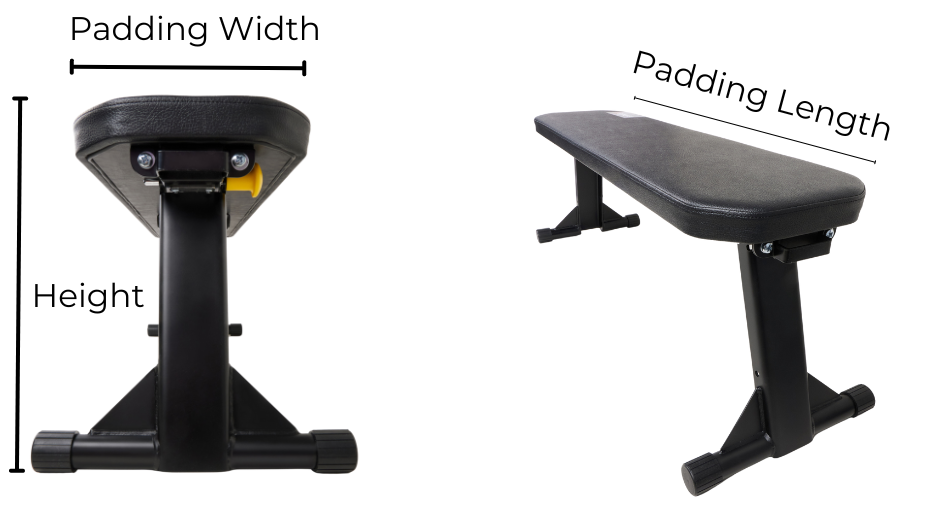
If you’re under 190cm tall, a bench width under 290mm is still acceptable. Padding width is essential for shoulder support. Bench height matters, too—if you’re shorter than 185cm, a height over 430mm might force excessive arching of your lower back during presses, which can cause pain. Ideally, look for 420mm to 430mm in height.
Also, if multiple people will use the bench, finding a middle-ground height and width is beneficial to suit a range of users.
2. Folded Size — and Folded Shape
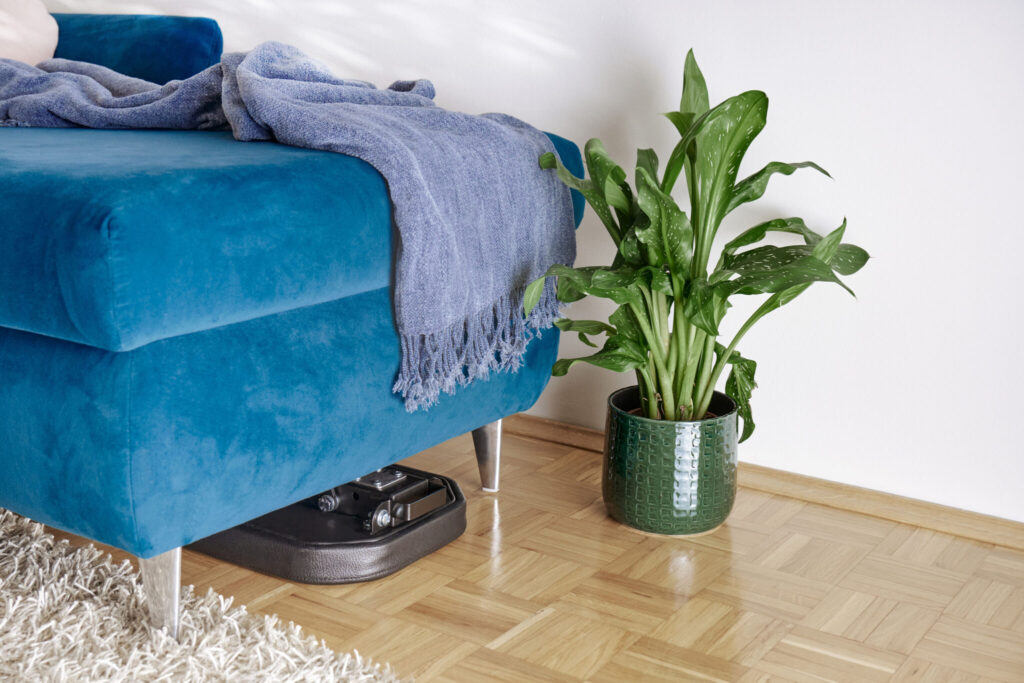
Look for: a flat, even profile under 10–12 cm, so the bench fits under a standard sofa or bed or hangs flat on a wall.
When people think about foldability, they usually focus only on folded size. However, the shape of the folded bench is often more important than the dimensions themselves. Check:
The dimensions when folded
The final shape (cube-like or flat)
Where you’ll store the bench at home — measure the clearance under your sofa or bed
Some benches fold into a compact, boxy shape that can be tucked into a closet. Others fold flat like a plank, which is perfect for sliding under a couch or hanging on a wall—like our patented MightyRock foldable weight bench.
If you’re training in a small apartment, a wall-mounted foldable bench can be one of the most practical storage solutions available. A truly space-efficient foldable weight bench should integrate naturally into your living space without turning storage into a daily frustration.
3. Stability and Base Width
Look for: legs wider than the pad, four points of floor contact and non-slip rubber feet.
Stability is difficult to judge online. Wide base legs (wider than the bench pad) and four points of floor contact are more stable than narrow or three-point designs. Customer reviews and independent video tests are your friend when it comes to identifying wobbly designs.
Non-slip feet or rubberized leg ends are a great addition for floors that are tiled or smooth. These also help prevent scratches on hardwood or laminate flooring.
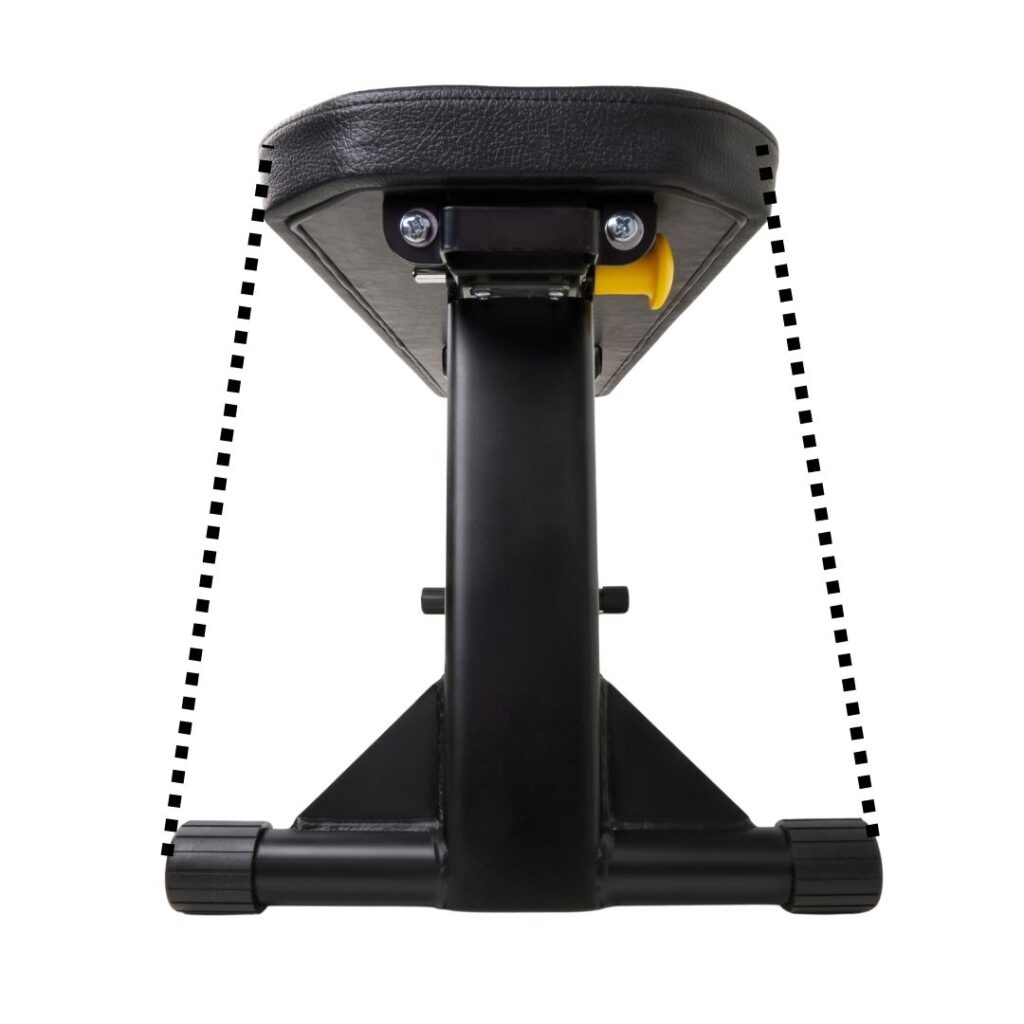
Bench stability is one of the most common concerns among home gym users. In our What Makes a Foldable Weight Bench Stable? Frame, Legs and Real-World Use article, we explain what actually makes a foldable weight bench stable.
4. Frame Rigidity
Look for: steel tubing, large reinforced brackets between pad and frame, a bench weight between roughly 10 and 20 kg.
A stable and rigid frame is essential for lifting safely. Look for benches made from steel tubes (rectangular or round). Avoid anything under 10kg, as it may not handle heavy weights well. On the flip side, benches over 20kg can be hard to move around the house.
The brackets connecting the padding to the frame also influence rigidity. Larger, sturdier brackets help prevent flexing during movements like tricep sit-ups. On our MightyRock bench, we reinforced these brackets so well you can even walk along the edge without bending the pad.
When evaluating rigidity, also inspect how tightly the parts lock together. Any looseness may worsen over time and compromise the safety of your workouts.
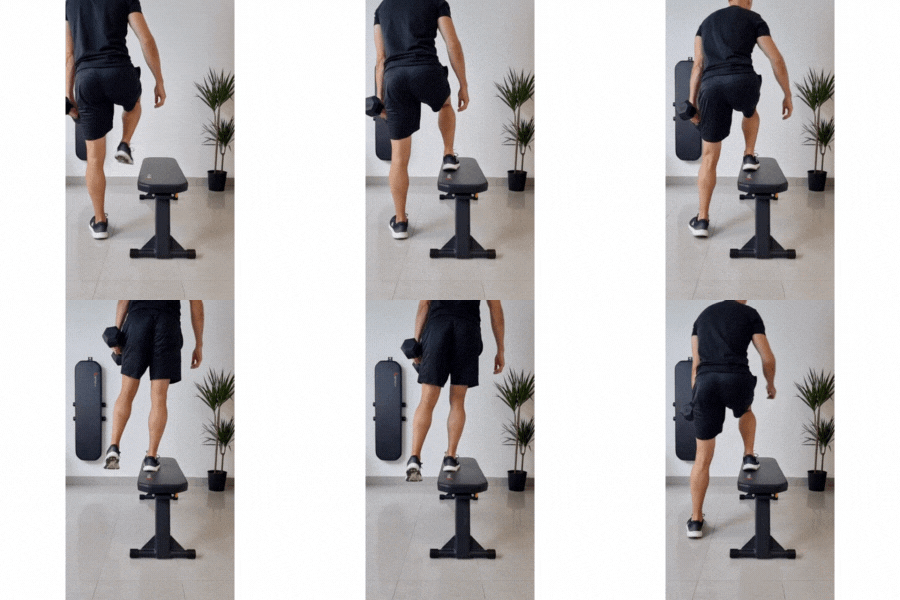
5. Steel Thickness
Look for: 2–3 mm steel tubing for the frame, with the thickness listed in the specifications, and a powder-coated finish.
Thinner steel lowers the weight capacity and stability. Reputable manufacturers should list this in the specs. Also, powder coating on the steel frame helps prevent rust and prolongs the life of the bench, especially in environments with humidity or temperature swings.
6. Load Capacity: Rating vs. Real Test
Look for: a rating that clearly covers user plus weights, and ideally an independent test that confirms it.
Load ratings are not all calculated the same way. Some only describe a static load placed gently on the pad, while real training adds dynamic forces: lowering dumbbells, stepping up, dipping. Choose a rating with a healthy margin above your bodyweight plus the heaviest weights you plan to use, and give more weight to numbers that have been verified independently and shown on video.
7. Padding Material
Look for: a firm, layered pad (chip foam or recycled cotton) on a solid base, with a grippy vinyl cover.
Padding directly affects your comfort and performance. It shouldn’t be too soft or too firm. Look for materials like chip foam or recycled cotton. PU foam, while commonly used, can be overly cushioned and make you sink into the pad. Quality benches use multiple material layers to balance comfort and firmness, rather than overly soft foam that compresses quickly over time.
Good padding ensures joint protection and helps maintain correct posture, which is critical for injury prevention. Cheaper models may cut corners here, so it’s worth investing in quality.
8. Folding Mechanism, Connections and Setup
Look for: few moving parts, a positive lock you can check at a glance, and setup in seconds without tools.
Benches use either welded joints or fasteners (bolts, nuts, pins). Welded joints should look seamless and sturdy. For home use, zinc-coated fasteners are sufficient; stainless steel isn’t necessary. Well-constructed connections help keep the bench silent during workouts, avoiding annoying squeaks or shifting sounds that can be distracting.
It’s also wise to consider the time and ease required to fold and unfold the bench. Some designs can be frustrating if not well engineered — and a bench that takes too long to set up is a bench you stop using.
How MightyRock Measures Up
We designed the MightyRock foldable weight bench around exactly these criteria. Here is how it compares, point by point:
| Criterion | What to look for | MightyRock |
|---|---|---|
| Dimensions | Pad 1070–1200 × 290–320 mm, height 420–450 mm | Pad 110 × 29 cm, height 43 cm, length 115 cm |
| Folded size and shape | Flat profile under 10–12 cm | 9.5 cm, flat — fits under a sofa or bed, or hangs on the wall bracket |
| Stability | Legs wider than the pad, four contact points, non-slip feet | Wide steel-plate legs with anti-slip rubber caps |
| Frame rigidity | Steel tubing, reinforced brackets | Welded steel frame with reinforced pad brackets |
| Steel thickness | 2–3 mm frame tubing | 2 mm frame tubing, 5 mm steel legs |
| Load capacity | Clear rating, ideally independently tested | Rated for 500 kg (user + weights), independently tested to 460 kg |
| Padding | Firm, layered, grippy cover | Textured vinyl, foam and recycled cotton on a 15 mm plywood base |
| Setup and safety | Positive lock, no tools | One magnetic safety pin per leg; arrives fully assembled |
Independent Proof, Not Just Our Word
- Independent load test: Thomas from HomeGymVault Europe tested the bench to 460 kg on video. Read the independent review of the MightyRock foldable weight bench.
- German review: the YouTube channel “HomeGym und mehr” put it through real training. See what the German review found.
- Patented design: the MightyRock’s shape is protected by a registered design patent.
- Warranty: 5-year commercial warranty on the steel load-bearing structure (frame and legs) and 2 years on all other parts, in addition to your statutory rights.
- Developed and assembled in Zagreb: designed in-house from sketch to 3D CAD by MightyLu.
MightyRock Foldable Weight Bench
Folds to 9.5 cm, rated for 500 kg, ships fully assembled. €215 incl. VAT.
Is a Foldable Weight Bench Suitable for Serious Training?
A common misconception is that foldable benches are only suitable for beginners. In reality, many experienced lifters successfully train at home using foldable benches — provided the bench is properly designed.
Stability, frame rigidity, and padding construction matter far more than whether a bench folds or not. When these elements are engineered correctly, a foldable bench can safely support demanding workouts while still offering the convenience of compact storage.
For home gyms, this balance between performance and practicality is often more important than absolute commercial-gym specifications.
A Complete Home Gym in Under 4 m²
Once you have chosen a bench, the next question is what goes around it. For most people training at home, a complete and genuinely compact setup is three things: a stable flat bench, a range of dumbbells and a way to do barbell-style lifts. With a 9.5 cm foldable bench, your dumbbells and a dumbbell-to-barbell converter you can train every major muscle group in less than 4 m² of floor space – and put everything away in minutes.
Questions to Ask Before You Buy
These are the questions we hear most often from people comparing benches. For general questions about foldable benches and MightyRock — height, weight, assembly, exercises — see our foldable weight bench FAQ.
Add your bodyweight to the heaviest dumbbells or barbell you expect to use, then leave a generous margin for dynamic movements such as lowering weights or step-ups. For most home lifters, a bench rated for at least 300 kg (user plus weights) is a sensible minimum; MightyRock is rated for 500 kg and was independently tested to 460 kg.
Measure the clearance between the floor and the underside of your sofa or bed frame and compare it with the bench’s folded height. Many sofas have about 10–12 cm of clearance, so a bench that folds to 13–16 cm will not fit; MightyRock folds to 9.5 cm.
If you want one bench for the widest range of exercises, start with a flat bench: it is more stable, has one continuous pad and folds flatter. Choose an adjustable bench only if incline pressing is your main goal; a flat bench can still be set to an incline with a simple support under one leg.
The price difference usually shows up in steel thickness, load rating, padding and how firmly the bench locks. A cheaper bench that wobbles or cannot handle step-ups limits what you can train and often gets replaced. If you train regularly, a bench built like commercial equipment is the better long-term buy.
No, but it is the easiest way to keep the floor completely clear. With the bracket, the folded bench hangs flat on the wall and you simply lift it off to train. If you prefer to store it under a sofa or bed, the bench alone is enough; MightyRock is available on its own or together with the wall bracket.
In the EU you always have at least two years of legal guarantee. A longer commercial warranty on the steel structure is a good sign that the manufacturer trusts its frame. MightyRock comes with a 5-year commercial warranty on the steel frame and legs and 2 years on all other parts, in addition to your statutory rights.
MightyRock ships fully assembled within 5–10 working days to the EU countries we deliver to. As a consumer you can withdraw from the purchase within 14 days of delivery; return shipping is paid by the customer.
Conclusion
Choosing the right foldable weight bench can significantly impact your home workouts. Whether you go for a flat or incline model, make sure to consider dimensions, rigidity, foldability, and padding quality to get the most out of your purchase.
If you’re building a home gym from scratch or just upgrading your current setup, a foldable bench is a smart, space-conscious investment. It enhances the range of exercises you can perform and allows you to maintain a consistent routine regardless of your schedule.
By prioritizing stability, smart engineering, and thoughtful design, you can enjoy the benefits of serious training at home — without sacrificing space or convenience.
If you are looking for a bench that meets every criterion in this guide, the MightyRock foldable weight bench for home training does: rated for 500 kg, independently tested to 460 kg, with 5 mm steel legs and a 29 cm pad, delivered fully assembled. Folded to 9.5 cm, it slides under the sofa or bed in seconds; for vertical storage, choose the MightyRock foldable weight bench with wall bracket.